He also said his country's sovereignty should be respected after drones were intercepted after entering Egyptian air space on Friday.
Israel on Friday said it was the target of the drones which it blamed on Yemen's Iranian-backed Houthi movement. Egypt's military said the drones, which fell on the Egyptian towns of Taba and Nuweiba near the Israeli border, injuring six, originated in the southern Red Sea. It did not say who launched the drones.
"Regardless of where it comes from, I have warned of the expansion of the conflict. The region will becoming a ticking time bomb that impacts us all," Sisi said, speaking at a conference.
"Egypt is a sovereign country and its sovereignty and position should be respected ... Egypt is a strong country and it is untouchable," he added.
Sisi held a peace summit last Saturday and has called for aid to be allowed into Gaza, the release of hostages, and a ceasefire in the Israel-Hamas conflict.
Iran sent a message to Israel on Saturday stressing that it does not want further escalation in the Hamas-Israel war, but that it will have to intervene if the Israeli operation in Gaza continues, two diplomatic sources with knowledge of the situation told Axios.
Why it matters: The fighting between Hamas and Israel will turn into a regional war if Iran gets involved either directly or indirectly, such as through a militant group in Syria or by backing any Hezbollah decision to fully join the fighting.
- Iran's message, sent to Israel through the UN, comes as the Biden administration has been trying to deter Iran and Lebanon-backed Hezbollah, supported by Iran, from joining the war. This week, the U.S. sent an aircraft carrier group and fighter jets to the region.
Behind the scenes: Iranian Foreign Minister Hossein Amir-Abdollahian met with UN envoy to the Middle East Tor Wennesland on Saturday in Beirut, the two diplomatic sources said.
- Wennesland urged Amir-Abdollahian to help prevent a spillover of the conflict in Gaza and Israel to the wider region in the Middle East.
- The Iranian foreign minister replied that Iran doesn't want the conflict to turn into a regional war and wants to try to help with the release of civilians who are being held hostage by Hamas in Gaza.
- But Amir-Abdollahian stressed that Iran has its red lines. He said that if the Israeli military operation continues — and especially if Israel follows through on its promise of a ground offensive in Gaza — Iran will have to respond, according to the sources.
Wennesland called Israeli national security adviser Tzachi Hanegbi and other officials and conveyed Iran's message, the sources said.
- Wennesland's office confirmed he met with Amir-Abdollahian on Saturday, saying they discussed "diplomatic efforts to release hostages, de-escalate and prevent a spillover of the conflict to the wider region."
- The Israeli Prime Minister's Office declined to comment. Iran's Ministry of Foreign Affairs did not immediately respond to a request for comment.
- "I know about the scenarios that Hezbollah has put in place," Amir-Abdollahian said. "Any step the resistance will take will cause a huge earthquake" for Israel.
The big picture: The latest fighting between Hamas and Israel began Oct. 7.
- Israel has continued its heavy bombardment of the Gaza Strip after Hamas' attack on Israel last Saturday. Violence also has been escalating along the Israel-Lebanon border and in the occupied West Bank.
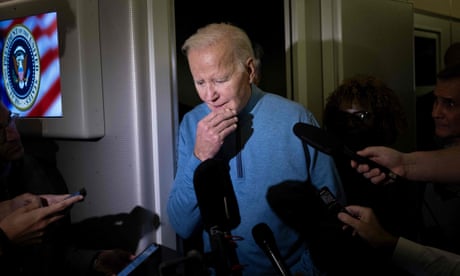
- More than 1,300 Israelis and 2,200 Palestinians have been killed.When Joe Biden, the US president, spoke to Israelis during his brief visit this week, he said he and “many Americans” understood “their shock, pain and rage”.
Then he added a warning. “Justice must be done. But I caution this – while you feel that rage, don’t be consumed by it. After 9/11, we were enraged in the United States. While we sought justice and got justice, we also made mistakes.”
The president might have felt that pointing to the US’s own failings, as well as its successes, could have a greater impact on Israelis, after the attacks launched by Hamas from Gaza that killed 1,400 people, rather than efforts to offer lessons in other, less empathic, ways.
He may also have hoped such comments on Wednesday would encourage Benjamin Netanyahu and his hardline rightwing government to moderate a response that has so far led to more than 3,000 deaths in Gaza and which promises many more in a conflict that will probably be grim and gruelling.
“Biden has been on a journey. He voted for the Iraq war in 2003 but under [Barack] Obama was one of the most cautious of the inner circle. He was only one who was against the raid that killed Osama bin Laden. He thought it too risky. He’s become a bit of a sceptic on foreign interventions and that’s based on his impression that the war on terror was by and large a mistake,” said Peter Neumann, professor of security studies at King’s College London.
Quite which of the many errors made by US policymakers after al-Qaida attacked New York and Washington, Biden was thinking of is unclear, but many might now act as warnings for Israeli policymakers.
One is the failure of focus that dogged the US response to 9/11. George Bush as US president not only opted for a massive but largely conventional military response to a threat posed by a small and non-conventional foe, but broadened the effort into an indiscriminate “war on terror”. This might have fulfilled the emotional need of its population for reassurance, retribution and the “justice” Biden spoke of in Israel, but it committed the US to an unending and eventually exhausting battle against an ill-defined enemy.
Netanyahu has told Israelis: “We will wipe this thing called Hamas, Isis-Gaza, off the face of the earth. It will cease to exist.” Tactical similarities exist between the atrocities perpetrated by Hamas and those of Islamic State but there are no organisational links between two very different groups.
Yossi Melman, the veteran intelligence reporter for Haaretz, told the Washington Post: “What does it mean to crush Hamas? Hamas is an ideology, like [IS]. It’s difficult to crush an idea.”
Netanyahu was probably citing IS as a rhetorical device. But with no strategic plan outlined by any Israeli official for a military victory there is a danger the campaign broadens as the conflict goes on. Keeping all Israelis safe all of the time is impossible, even if the deterrent effect that is at the heart of Israeli security doctrine can be restored, however bloodily. Thus Biden’s warning.
Then there have been the conscious decisions taken by US policymakers to ignore the basic recognised ethical, law and even professional practices of war.
This outlook permitted the human rights abuses associated with Guantánamo Bay, CIA renditions, and torture. Instead of “moral clarity” this dragged the US into a world of cynical violence and illegality that appalled supporters and, especially as sweeping security measures were introduced, was demoralising at home.
It was also often counterproductive, leading to greater numbers of extremist recruits. Al-Qaida and other groups are already exploiting images of suffering in Gaza.
Biden could also be warning Israel not to misjudge its own capabilities. The ambitions of the war on terror overwhelmed realistic appraisals of resources available even to the US. There was the poorly considered and resourced nation-building effort in Afghanistan and the biggest single blunder of all: the invasion of Iraq. Supporters in Washington believed they could remake the Middle East. Instead the unnecessary intervention had devastating consequences for regional and global security.
One particularly problematic thought is that in the immediate aftermath of the 9/11 attacks, Syria and Iran sought better relations with the US, offering desperately needed intelligence on al-Qaida or even captive senior militants as a token of good will. Both were rebuffed, with Iran included alongside Iraq and North Korea in the “axis of evil” described by Bush in his 2002 State of the Union address.
Now Syria and Iran are bitter enemies of both the US and Israel, and could play deciding roles in the current unfolding crisis. If Tehran launches Hezbollah in a full-scale attack across the border from its strongholds in southern Lebanon or through the Golan heights, Israel will find itself caught in a two-front war. This might well pose an existential threat, forcing the US to intervene in a new and very direct way.
Perhaps what was uppermost in Biden’s mind was how the vast outpouring of sympathy for the US in the immediate aftermath of the 9/11 attacks turned to concern, frustration and then often deep anger.
“Americans overestimated how much the hurt and anger that the US was experiencing was what the world was experiencing … A lot of people in the world, including allies, don’t see it the way the Israelis do and won’t support them all the way. The dynamics have changed for Israel but not for the rest of the world. That’s a lesson the US learned the hard way, and Israel is at risk of falling into the same trap,” said Neumann.
Biden might remember how, when Obama made his speech in Cairo in 2009 after eight years of the war on terror, seeking “a new beginning” in relations with the Islamic world, it was far too late. A wave of polarisation and radicalisation had swept across much of the world.
“The vast majority of Palestinians are not Hamas … Hamas does not represent the Palestinian people,” Biden told Israelis. A few hours later, he was on his way back to Washington.
7 October 2023 seems certain to become an infamous day for the Middle East and for the world, after Hamas’s murderous onslaught into Israel sparked a crisis still raging across the region. In its first weeks, the Israel-Hamas war has already seen significant bloodshed on both sides, as well as a humanitarian crisis in Gaza. The ripple effects have been felt globally, with foreign leaders flying to the region to try and prevent escalation, and spikes in antisemitic and Islamophobic hate crime reported in the US and Europe.
As the Guardian’s Head of International News, making sense of this rapidly developing conflict is a round-the-clock job for me and my colleagues on the international desks in London, New York and Sydney. Over recent years, we have continued to invest in correspondents able to tell this story from the ground and in experienced, expert journalists and commentators who can analyse and make sense of the situation and what it means for the world and our millions of readers.
It takes all of our collective skills and resources to keep our liveblog running 24/7 - and to ensure our coverage is comprehensive, informed, accurate, and fair.
We are committed to covering every aspect of this war, from the ordinary people caught up in it to the regional and global ramifications. We are committed, too, to combatting the vast amount of misinformation, rumour and hate swirling online.