

However, the same day as the meeting, Azerbaijan announced the start of joint military drills with its ally Turkiye near the border with Armenia just weeks after Baku seized Karabakh from pro-Yerevan separatists.
At the meeting in the Iranian capital — which also included foreign ministers from Turkiye, Russia and Iran — the envoys noted a push for peace in the Caucasus.
“This meeting... can be the cornerstone of the path toward establishing peace and ending challenges in the South Caucasus with the participation of regional players and neighbors,” said Iran’s Foreign Minister Hossein Amir-Abdollahian.
The talks are seen as Moscow’s attempt to reduce growing Western influence in the Caucasus — a region it has long considered as its backyard.
According to Moscow’s original plan, the “3+3 format” was meant to also include Georgia. But Tbilisi, which aspires to join the EU and NATO, has rejected the proposal.
Since Moscow brokered a 2020 cease-fire between Armenia and Azerbaijan, the European Union and United States have stepped up their own efforts to mediate a peace agreement between the two sides.
Russia, the traditional power-broker in the region, has seen its role diminished since it invaded Ukraine in February 2022.
Ahead of the talks, Azerbaijan’s defense ministry said Monday it had begun joint drills with its ally Turkiye near the border with Armenia — weeks after Baku seized the long-disputed Nagorno-Karabakh region from pro-Yerevan separatists.
Azerbaijan last month took control of the enclave in a 24-hour military operation that ended decades of Armenian separatist rule.
The ministry said “up to 3,000” troops would take part in the tactical drills held in the capital Baku, the Nakhichevan exclave between Iran and Armenia, as well as territories retaken from Armenian separatists.
The exercises — dubbed “Mustafa Kemal Ataturk 2023” — involve dozens of artillery weapons and aviation.
Baku said they were aimed at “ensuring combat interoperability” between the allies.
Tensions are running high between Armenia and Azerbaijan, a month after Baku’s lightning offensive.
Yerevan fears that energy-rich Baku may seek to press its advantage — with the help of Ankara — to forcibly connect its Nakhichevan exclave with Azerbaijan proper by capturing lands in southern Armenia, along the Iranian border.
Iran opposes the idea of a so-called Zangezur corridor, as it would create a direct land link between Azerbaijan and Tehran’s historic rival Turkiye.
Armenia said it is ready to reopen transport communications between mainland Azerbaijan and Nakhichevan via its territory under condition that its sovereignty over the area is not questioned.
Baku has denied having any territorial claims over Armenia.
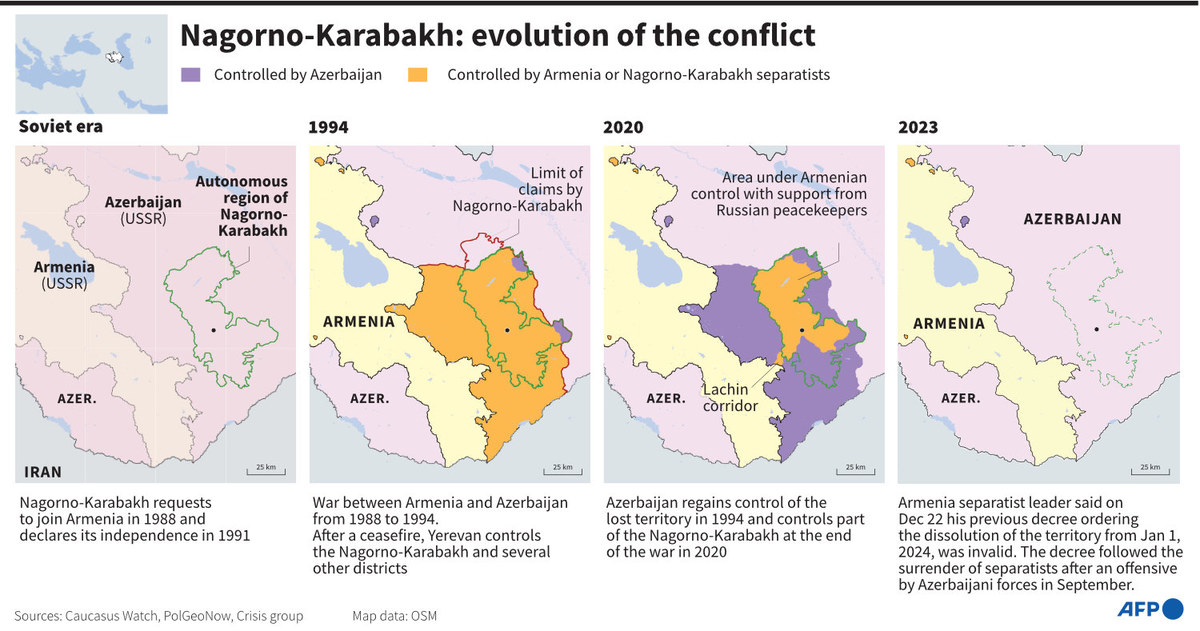
Karabakh, internationally recognized as part of Azerbaijan and for decades home to a majority Armenian population, was at the center of two wars between Yerevan and Baku — in 2020 and in the early 1990s following the collapse of the Soviet Union.
After a months-long blockade of the region, Azerbaijan launched a lightning offensive against Armenian separatist forces on September 19, 2023.
After less than a day of fighting, separatist authorities agreed to lay down arms and reintegrate with Azerbaijan.
Almost all of Nagorno-Karabakh’s ethnic Armenian population — some 100,000 people — fled for Armenia after the offensive, sparking a refugee crisis.Armenian Prime Minister Nikol Pashinyan said on Sunday that he has proposed the signing of a non-aggression pact to Azerbaijan, pending a comprehensive peace treaty between the arch-foe Caucasus neighbors.
Yerevan and Baku have fought two wars — in 2020 and in the 1990s — over the disputed Nagorno-Karabakh region, which Azerbaijan recaptured in a lightning offensive last year.
“We have presented Azerbaijan with a proposal for a mutual arms control mechanism and the signing of a non-aggression pact if the signature of a peace treaty encounters delays,” Pashinyan said in a speech during an Armenian Army Day celebration event.
He also said that Armenia — a longstanding ally of Russia which had voiced fears of Azerbaijani military moves against its territory — must revise its security arrangements.
“We need to reconsider our strategic thinking in the security sphere and diversify our (international) relations in that sphere,” Pashinyan said.
“We are set to purchase new and modern weapons, and over the last years the government has signed contracts on arms procurement worth billions of dollars,” he added.
Azerbaijan has denied having territorial claims to Armenia and ruled out a fresh conflict with its fellow ex-Soviet republic.
Pashinyan and Azerbaijani President Ilham Aliyev had previously said a peace agreement could have been signed by the end of the last year.
But internationally mediated peace talks have so far failed to produce a breakthrough.
Last month, Armenia and Azerbaijan swapped prisoners of war, a first step toward normalizing relations.
The European Union, the United States as well as regional powers Turkiye and Russia have praised the move as a “breakthrough.”
The prisoner exchange raised hopes for reviving face-to-face talks between Pashinyan and Aliyev.
The pair have met several times for normalization talks mediated by EU chief Charles Michel.
But the process has been on hold since October.
Traditional regional power broker Russia, bogged down with its dragging Ukraine offensive, has seen its influence wane in the Caucasus.
Aliyev sent troops to Karabakh on September 19 and after just one day of fighting Armenian separatists — who had controlled the region for three decades — surrendered and agreed to reintegrate with Baku.
But in December, separatist leader Samvel Shahramanyan said in Yerevan that his previous decree ordering the dissolution of separatist institutions was not valid.
Almost the entire ethnic-Armenian population — more than 100,00 people — fled Karabakh for Armenia following Baku’s takeover, sparking a refugee crisis.
Azerbaijan’s victory in September marked the end of the territorial dispute, which had long been seen as unresolvable.